One call and we take it all
Categories
Rubbish Removal Sydney Rubbish Removal Rubbish Recycling

Commercial Rubbish Removal – 5 Reasons You Should Outsource

Businesses generate waste or waste by-products. It’s a natural part of owning and operating a business, but that doesn’t mean there isn’t steps owners can take to reduce their footprint. Handling your due diligence to ensure you properly dispose of commercial waste can take a lot of time, energy, and money. You might not realise it, but outsourcing could save you money, as well as time and energy. 

5 Reasons You Should Outsource 

1. It’s Eco-Friendly 

A reputable rubbish removal company will have an eco-friendly policy. You should only enlist the services of a rubbish removal company that does. When you do, you can rest easy knowing that all of your commercial rubbish will be dealt with appropriately. At Cheapest Load of Rubbish, we aim to ensure 80% of the rubbish we remove is recycled or reused, with only 20% ending up at landfills. It’s not just good for the environment, it’s better for business. 

2. It’s Cost-Effective 

There is an immediate cost associated with outsourcing your rubbish removal. However, this is offset by long-term savings. It is far more costly to deal with rubbish removal yourself, and rarely are these ongoing costs viable. When you outsource, you do so to a team of experts rather than having your in-house team deal with something they didn’t train to do. 

3. It’s Time-Saving 

You don’t have to chase your employees up to handle waste removal. You don’t need to worry that they’re disposing of things properly. Why would you want to pay them to do a job you didn’t hire them to do? Especially when there are plenty of highly skilled commercial rubbish removal companies who can do it for you? It’s time-saving, cost-saving, and energy saving. Which lets your team do what they do best. 

4. It’s Fast 

When you enlist the services of a respected rubbish removal company, you get a team of trained and experienced individuals who work efficiently. They work quickly, efficiently, and accurately. Your waste will always end up in the right place, whether it’s a landfill or recycling centre. 

5. The Work Is Guaranteed 

At Cheapest Load of Rubbish, we stand by every job we do. We will take you through what you can expect from working with us, what our team will do for you, and how we follow through. You can address any concerns you may have or make special requests to accommodate your unique needs. 

Commercial Rubbish 

Commercial rubbish is any rubbish that a business produces. Non-profit organisation waste is also classed as commercial, and garden clippings from maintaining a business also count. Commercial waste is treated differently from domestic waste for several reasons. First, there is an element of compliance requirements. There is also a difference in charging for domestic versus commercial curbside collections. Additionally, some waste is classified as regulated and requires appropriate handling. Of course, the most obvious issue is that businesses generate far more waste than residential areas. 

If you need commercial rubbish removal in Sydney, it includes any waste generated by carrying out any the following activities:

  • wholesalers trade
  • retailers
  • manufacturing
  • industrial processes
  • veterinary services
  • mining
  • hospitality
  • health services
  • accommodation services
  • agricultural
  • fishing
  • forestry
  • educational services
  • charity or church activities
  • entertainment events
  • any business or administrative activity or service


Every business will produce its own type of rubbish, so there are no hard and fast rules as to what qualifies as commercial waste, aside from it being what a business produces. However, there are limits as to what can be disposed of without specialist assistance. 

The Importance of Cleanliness 

Keeping a tidy work environment is important for a host of reasons. 

Firstly, it keeps your team safe, for one. Clutter is a trip hazard, and having a rubbish removal team remove the risk helps keep your accidents and incidents down. 

Secondly, it prevents pest activity. The more places for pests to hide, the bigger your problem will be. By having your rubbish removed regularly, you take away any temptation for pests to make a home on your business premises. 

Finally, studies show that a clean and tidy workplace motivates employees, increases professionalism, and results in fewer sick days. Every business owner wants a motivated workforce that maintains high productivity rates. Their working environment contributes to their morale, which influences their productivity. So, by ensuring rubbish is regularly removed from the premises, you contribute to a healthier working environment. 

How Cheapest Load of Rubbish Can Help 

Get in touch with us today to organise your recurring pick-up, whether it’s weekly, fortnightly, or you have something else in mind. We would be happy to discuss your needs and provide you with a quote for our services. Whether you need a one-time rubbish removal Sydney or a recurring service, we would be happy to work with you. We offer a wide range of services for commercial, residential, construction waste and more.

Categories
Rubbish Removal Sydney Rubbish Removal Rubbish Recycling

Dangers of Dust in Your Household & Why you Need Rubbish Removal

You dust, sweep, hoover, and wipe down, but as hard as you try to stay dust-free, it still sneaks in. With so much of our time spent indoors, we constantly face poor indoor air quality. Experts recommend great ventilation, and if you don’t have an HVAC system to filter your indoor air, you should open your windows regularly. It improves the quality of your indoor air. However, it also provides dust with another entry point. 

What is Dust? 

According to a report from the Economic Times, a third of dust is created in your home. What it is made up of all depends on your home and habits. Scientists don’t have an exact formula. If you live in an older home, with pets and everyone smokes, your dust will be made up of different contaminants than someone in a newer home with no pets or smokers. The one thing dust does have in common is human detritus. Our skin cells slough off and contributes to dust, as do those from your pet. Dust can include dust mites, food debris, and even decomposing insects. Not to mention fibres from materials within your home and the grime you track into your home on your shoes and clothing. 

What Dangers Come With Dust? 

Since dust accumulates in your home no matter how hard you work to clear it out, it circulates in the air. You inhale that dust, and with all the man made chemicals that make their way into it, it’s hazardous to your health. It is of particular concern for people with allergies and respiratory issues. 

If a third of dust is created indoors, two-thirds come from outside. It enters through doorways, windows, and vents. It comes in on your clothing, footwear and pet fur and feet. This dust may be made up of tiny soil particles or large pollens. Lead, however, is another risk, especially if you live in the city, near a mine, or another industrial area. This can result in lead poisoning, which can lead to a wide range of health issues, including permanent disabilities. 

One of the most common ways dust forms in your home is shedding from outside clothing. When you enter your home, you should remove your shoes and immediately remove your jacket. According to a study from the University of Arizona, 96% of shoe soles have traces of faeces. The study tracked a group of people wearing brand new shoes for two weeks. The rate of transfer from shoe to the floor? Up to 99%. This was just a study looking at the faecal matter, but add in the other toxins you come into contact with. For example, as you cross lawns, you run into chemicals, as you would in public restrooms. All of these are tracked into your home on your shoes. 

Ways Dust Is Forming In Your Home 

Mould is a big contributor to dust, and by using air purifiers you can help tackle some of that. They don’t kill mould before it grows, and they can’t prevent it, but they do kill the mould that hits the air. When you clean you kick up dust and mould, and your air purifier takes care of it. Food debris is also a big contributor to dust. 

A long, hot shower contributes to mould growth, as do your shower sponges, toothbrushes, and any other product that comes into contact with you. You should always wash or replace these items regularly and dry them after use. Grooming is another dust contributor, with aerosols putting particulates into the air. 

Dead skill cells shouldn’t come as a surprise. The area where most of these slough off is your bed. So, change your sheets at least once a week to manage dust. Your area rugs are also a major factor. They catch everything. Hoover them at least once a week, take them out back and air them, beat them with a stick, and have them professionally cleaned annually. 

Your beloved pet isn’t helping your dust situation. There isn’t a lot you can do about it, aside from regular bathing, brushing, and hoovering. Air purifiers will also help manage the pet hair and danger that does escape. You can manage it by sweeping, mopping, dusting or hoovering daily. 

How Dust Affects Your Health 

The biggest health issue as a result of dust is respiratory. If you have a respiratory issue you will have a more difficult time. Typically, dust causes eye irritation, hay fever, sneezing, coughing, and asthma attacks. Young children, the elderly, and those with existing respiratory or heart conditions are at the greatest risk. 

Ways To Cut Down On Dust In Your House 

You can start by leaving your shoes and jackets at the door. Next, you can make a cleaning rota to ensure you are changing sheets weekly, hoovering regularly, and staying on top of dusting. Don’t forget to wipe down the tops of cupboards with a damp cloth. Once you wash down your counters and cupboards you should revisit to dry surfaces. 

At least once a month, you should move furniture and appliances for a deeper hoover clean. You can also use your vacuum to clean your furniture, especially where your pets spend time. Don’t forget your blinds and curtains, and your walls! You can easily tackle dust with a wipe, hoover, or damp cloth. Certain wall types are at greater risk of mould growth, and accumulating dust can contribute to that. 

Dust your light fixtures and lampshades and get in behind your radiators. As dust collects behind these it is distributed throughout the air once on. 

Clutter is another major issue for dust. The more clutter you have, the more surface area available for the dust to cling to. Clearing out old furniture and unused items is a good way to stay on top of the issue. 

How Cheapest Load of Rubbish Can Help 

If you are looking to get your home in tip-top shape to reduce the risk of dust and mould growth, then it’s time to deal with the clutter and call a professional rubbish removal service. Once you have a full-scale clear-out, you can use a handy company like Cheapest Load of Rubbish for rubbish removal in Sydney.

Categories
Rubbish Removal Sydney Rubbish Removal Rubbish Recycling

Rental House Rubbish Removal – The Ultimate Check List

Moving is stressful enough, but it’s even more stressful when you are a renter. On top of a full house clearance, you have to consider the extra cleaning to make sure you get your bond back in full. What you need is a checklist to keep you on track. 

Timing 

Don’t leave everything to the last minute or you will never get it all done on time. Make a list of every task you need to do and give yourself enough time to get it done. How long it all takes will depend on the size of the property, but your best bet is to give yourself at least half a day to tackle each room. If rooms are messier or larger, then dedicate a full day to the task. The best way to manage stress is to manage your time. 

To Keep or Not To Keep 

As you tackle each room, you will need to consider what is moving with you and what isn’t. You can either create piles for each or use colour coded stickers to organise. With children, allowing them to label what they must take and what can be donated, sold, or binned will help you clear out when you get to their rooms. 

You will have to be ruthless at this stage. Just think, the more you get rid of now, the less you will have to pack up and unpack at the other end. Once you’ve labelled everything, you can shift all of the charity items together, get the items ready for packing, and decide how best to bin the rest. 

Box The For Keeps 

There’s nothing too complicated about this stage, but you should have packing materials on hand to ensure everything is properly protected. In addition to boxes, you will want bubble wrap, labels, and new markers. For each box, write its intended destination. For example, dining room, master bedroom, etc. You can also write a brief description of the contents to make unpacking easier. And, once an entire room is packed, you should number the boxes 1 of, 2 of, etc. That way, you can easily keep track of what’s missing. 

It should go without saying that you have a basics box for your first evening, with all of the essential kitchen and bathroom items you will need for dinner, a brew, and a bath. 

Sell, Donate, or Rubbish Removal for the Rest 

You know what to pack, but what do you do with the rest of your stuff? It’s time to decide whether to sell it, donate it, or call in a rubbish removal company to haul it away. 

Sell

The internet is a wonderful thing, and it’s a great way to sell off unwanted items. It does require time and effort, which are in short supply when moving. Or, you could have a garage sale. 

Donate

Depending on the items you have to donate, the charity may be able to collect larger pieces. It’s important to remember these need to be in saleable condition; they aren’t a rubbish removal company. They can refuse to take things. Alternatively, you could make these drop-offs directly.

Rubbish Removal

Every company will operate differently, but your best bet to get the best price is to break your rubbish down as much as possible. Companies charge by volume so, this will help keep your costs as low as possible. You can either send a detailed list for a rough quote or have someone come out to give you a full quote. Your local council offers bulk pick-ups if you need old mattresses or appliances uplifted, but you need to check the dates to see if it’s worth waiting.

Finally, you might want to hire a professional cleaning service to carry out a final clean. It’s one last thing you can cross off your to-do list, and you can trust a professional service to get the job done right. A good bond cleaner will guarantee their work, so you don’t need to worry about getting ripped off twice. 

The Details 

Don’t forget to change your address, pay off outstanding bills, and disconnect utilities at the old property. Likewise, you will need to take steps to connect your utilities at the new property, including water, gas, electricity, and internet. Get the latter dealt with as soon as possible because you don’t want to be without it for weeks while you wait for connection. 

How Cheapest Load of Rubbish Can Help Rubbish Removal Sydney 

If you are looking for a professional rubbish removal company to handle the heavy lifting, you are in luck. That’s precisely what Cheapest Load of Rubbish can provide you with. Contact us with a description of the services you require and let us do the rest. If you need same-day service, phone us directly to discuss your load of rubbish.

Categories
Rubbish Removal Rubbish Removal Sydney Rubbish Recycling

Garden Rubbish Removal – Prepare Your Backyard For Fire Season

Wherever you live, you should take steps to prepare your backyard for fire season. While the dates vary each year and for every council, most of NSW go into fire season in early October. Once in effect, residents must notify their council of an intent to burn and secure a free permit to do so in their backyard. You must do this at least 24 hours before your planned burn, and you must also notify the neighbours of your plans. We all have a role to play in keeping our neighbourhood safe and yours doesn’t stop with safe burning. There are plenty of backyard hazards that could contribute to fires. So, it’s time to prepare yours for fire season. 

Why You Need To Prepare Your Backyard For Fire Season 

Everyone needs a plan in place for fire season, whether it’s to leave early or to shelter in place. But, it isn’t just you who needs a fire plan in place. It is just as important to consider your home’s fire plan. By preparing your backyard and home for fire season, you give firefighters the best chance possible to fight fires quickly. The quicker they can contain the spread, the more efficiently they can remove the danger and get things under control. 

Taking steps to prepare your backyard also helps protect your neighbours’ homes and provides you with more protection if you are forced to shelter in place and cannot escape. It’s important that everyone works together to protect the community. 

How to Prepare Your Backyard For Fire Season 

For starters, you can pop your address in the fire risk assessment tool provided by the NSW Rural Fire Service. This will allow you to complete a form that will rate your risk of bush fire. Whatever the result, you will be offered advice as to how best to prepare your property for the fire season. Additionally, based on your home’s construction, the tool will tell you whether your best bet is to leave early or to shelter in place. 

Garden Cleanup

You can prevent fire from spreading to your home by trimming shrubs and overhanging trees. Mow the lawn, remove the cuttings, and clear the area around your home. If it comes to it, it will provide firefighters with a safe working area. 

Clear Your Gutters

Any leaves and debris in your gutters can serve as kindling for an already raging fire. It’s important that you thoroughly clean your gutters before fire season kicks off. A fire sprinkler system for your gutters may be something to consider if you live in a high-risk neighbourhood.

Rubbish Removal

Wood piles, furniture, doormats, leaves, and mulch can all contribute to fires. This is material you should remove from around your home and garden. If you have a dilapidated wooden shed, break it down and get rid of it. Look at your garden through the eyes of a firefighter and consider what risks it prevents this fire season. If you can’t store it safely, you need to remove it. 

Protective Measures

If you don’t already, you should install a sturdy hose. This should be long enough to reach right the way around your home. You should also have a reliable stock of water, whether it’s a tank, dam or pool. If you do have a reliable stock of water, you can hang a Static Water Supply sign at the entrance to your property to alert firefighters. Having a pump available is also useful, and while petrol is fine, diesel is the safer option of the two. 

You can take additional protective measures by replacing missing roof tiles, repairing damaged ones, and installing metal guards on your gutters. Further, you can cover and repair external wall gaps, fit seals around windows and doors to keep smoke out and install mesh screens on doors and windows.

It should go without saying that you should maintain up to date home and contents insurance. 

How Cheapest Load of Rubbish Can Help With Rubbish Removal Sydney 

If you have a big job on your hands, call in the professionals to handle your rubbish removal. Whether you are looking to have bulk items cleared out or you have a load of garden waste to ditch, a member of our team can be with you as soon as today to provide you with a free quote. If you are happy with the quote, the team can remove your load there and then! If you have a pressing removal, phone the office direct for same-day service. If not, you can use the contact form or email us about your request. If you have an item or two to remove and you would like a better idea of how much uplift will cost, you can send us a detailed list and description for more information.

Categories
Rubbish Removal Sydney Rubbish Removal Rubbish Recycling

Bulky Rubbish Removal – How To Get Rid Of Your Junk

If you love to spring clean, then you will know just how expensive it can be to rid your home of bulky rubbish. Luckily, there are plenty of ways to reduce the cost of clearing out your junk. It’s all about knowing what it is, where it goes, and whether it can be used again as something else or by someone else. 

Can You Reuse It?

Before you ditch it at the dump, you need to ask yourself whether the item can be repurposed for your use. Will a coat of paint and a move to somewhere else in your home breathe new life into the item? You never know what you can upcycle. 

Or, if someone else can make use of it. If the item is clean and works, then it is an easy yes. For larger items, the charity may send a van to collect your haul. If it’s possible someone could repair it, you can make sure it gets to the right place. Your old gadget could find a new home somewhere, even if it’s three console generations ago. Of course, you can also sell it to earn a bit of extra cash, but it will take more time and effort. 

A Removal Company 

There are two different options when dealing with removal companies. You can choose between a rubbish removal company that carts all your junk off. Or, you could go with a house clearance company. The latter will take all of your junk and sell it off. 

A Tip Trip 

The cheapest way to dump your junk is to load up your vehicle and make a trip to the tip. Generally, it’s under $100 for local residents with a car. However, if you have or rent a ute to make your tip trip, you may be knocked back or charged more for the pleasure. There are different rules for trade waste, which you may fall prey to when driving a van. 

Council Collection 

Your local council provides a bulk waste collection service. This service is for household items, such as appliances, furniture, carpets, and mattresses. You need to book a collection and leave your waste on the curb the evening before collection. Be sure to follow the rules because you can be fined if you leave out banned items. 

Break it Down and Sort It

When you call a rubbish removal company, they will provide you with a quote based on the volume and type of rubbish you have. So, to save cash, you can break it down and dismantle light furniture to take up less space. If it looks like it can be broken down and you have the time and energy to do so, do it as it will save you money. Sorting your rubbish into waste types will also help to keep your price down.

Renovation Team 

If you are renovating your home, you can speak to the contractors about removing waste for free. This is something you will need to discuss before you sign on the dotted line. Otherwise, they’ll try to tack on an extra charge or just leave you with it when they’re done. Make rubbish removal part of the deal. 

Rubbish Removal Sydney 

Whether you are worried about costs or not, an affordable rubbish removal service will eliminate the hassle. You decide what to clear out and let professionals like Cheapest Load of Rubbish do the rest. Contact us for your free quote and we could be with you as soon as today. 

Commonly Asked Questions 

Q. Do you remove bulky items from residential properties? What is classed as a bulk item?

A. Yes, we provide our services to residential properties. We are happy to remove mattresses, furniture, cabinetry, carpets, pool tables, spas, televisions, appliances, and more. 

Q. Do you remove bulky items from commercial properties? What is classed as a bulk item?

A. Yes, we provide our services to commercial properties. We are happy to remove bulky office items, such as computers, photocopiers, and printers. We also clear warehouse rubbish, storage unit rubbish, hotel furniture, gym equipment, and more. 

Q.How much does bulk item removal cost?

A. This varies by item and is discussed on a case-by-case basis. At Cheapest Load of Rubbish we come out to your business or home and see for ourselves the amount of rubbish you need removed. This allows us to accurately quote you on the amount of rubbish that you have. Unlike other companies that quote on a m2 basis regardless of if you use the whole truck or not. Fill in our contact form and we’ll call you as soon as possible. 

Q. How much is the service?

A. We provide free quotes for our services. Once you contact us, one of our team will attend your property to provide you with a quote based on the items you need to be removed. Alternatively, you can send us a list of the items you want rid of and we can deal with your enquiry from there. The total cost will factor in several elements – the type of rubbish, the volume of rubbish, the pickup location, the schedule, and the amount of work involved.

Categories
Rubbish Removal Sydney Rubbish Removal Rubbish Recycling

Surprising Everyday Products You Can Reuse

You might keep hold of gift bags during the holiday season or a sturdy cardboard box here and there. There are loads of other everyday items you can hold onto and reuse all year round. If you’re mindful about the environment, you need to know exactly which everyday products you can reuse. The same goes if you are looking to save money and reduce your waste footprint. 

Old Containers 

The most obvious containers to reuse are glass products. They’re durable and generally come with their own lid. You can use them in the shed to keep track of loose screws and other odds and ends. Or repurpose them to store bulk ingredients in the pantry. Large plastic containers like soft drink bottles can be used to store natural cleaners, turned into bird feeders, or even serve as dust pans in the garden. Takeout containers are also a boon. Most of them are microwave, freezer, and dishwasher safe, so you can use them to freeze a large batch of soup. Finally, you can even use tin cans! Use tins as starter pots for your favourite plants or to start a herb garden on your kitchen window. 

Cardboard & Paper 

The beauty of the cardboard box is you can break it down, store it flat, and build it when you need it. It’s a handy item to have for moving day or for storage. 

Old paper can be used as drawing paper, scrap paper, it can be shredded to use underneath kitty litter, in animal cages, gift bags, packaging, or you can donate it to your local animal shelter. Old newspapers and magazines can also be shredded and used. Or, you can leave them whole and use them as wrapping paper for gifts. Paper bags are a great item to keep hold of. You can use them to make packed lunches, pack leftovers for guests, or even as paper holders for your recycling area. 

Dryer Sheets 

Your impulse might be to toss your old dryer sheets, but before you do, use them again. They are great for dusting, polishing chrome, and getting rid of soap scum. 

Toothbrushes 

You should change your toothbrush at least once a quarter, but when you do, keep ahold of it and use it as a little scrub brush to reach those awkward spots or to make your grout look new. They can also be used for applying hair colour or to clean tools. 

Plastic Bags 

While most states are cracking down on single-use plastic bags, you can utilise the remaining plastic bags in daily life. For example, once your cereal is finished you can repurpose the inner bag as a sandwich wrap. They can be used as bags for food or pet waste, too. 

Broken Dishes 

Just because you dropped your favourite mug doesn’t mean you’ve seen the end of it. Old or broken dishes have a variety of purposes. You can use it to make jewellery, re-tile garden tables, or even save them up to create a unique garden bed border. If it’s only a broken handle, you may be able to use that broken mug as a plant pot. 

Textiles 

You can take old bedding, towels, and clothes to a charity shop, but if they’re looking worse for wear, you can cut them into strips and use them for cleaning. Alternatively, you can take all those old button-down shirts and have pillows or blankets made. 

Old Furniture 

Instead of ditching old furniture, breathe new life into it. You can either refinish and repair it or, you can repurpose it for a new life. If you don’t want to go to the effort, you can always ensure it ends up in the hands of someone who enjoys upcycling old furniture. That way you know someone else will get to enjoy it.

Reduce, Reuse, Recycle 

There are loads of everyday items in your home that you bin without thinking, but so many can be reused for different purposes. Even if you get another use or two out of them, it’s better than sending them straight to the rubbish. If you use the cereal bag for sandwiches, you’re reducing other waste. 

Cheapest Load of Rubbish Removal Sydney 

If you’re moving house, having a clear-out, or renovating, use a professional rubbish removal service to make life hassle-free. A professional company will ensure all of your waste ends up at the right facility, whether it’s the landfill or a recycling centre. You don’t even need to worry about making separate piles; skilled technicians will ensure all your waste is properly separated. 

Cheapest Load of Rubbish Removal Sydney offers a wide variety of services, including residential and commercial rubbish removal, construction rubbish removal, mattress removal, household rubbish removal, furniture removal, garden waste removal, deceased estate removal, same-day rubbish removal, and more. Get in touch with us today for a free quote.

Categories
Rubbish Recycling

10 Facts About Rubbish Removal & Recycling

 Australia has been identified as one of the largest waste producers in the world. Though we do make an effort to recycle, we also produce an alarming amount of waste. Do you just toss rubbish into the bin and forget about it? You’re not alone, but we can do better than that. There’s a right way and a wrong way to manage rubbish. 

10 Facts About Recycling & Rubbish 

As a consumer, the best way for you to reduce your waste is to focus on sorting your rubbish carefully to ensure everything is disposed of or recycled properly. In addition to kerbside recycling, you can return certain items to stores, use container deposit schemes, or enlist the services of a professional rubbish removal company. The statistics and studies are clear; we have to take more responsibility for our waste. 

  1. According to an ABC report, Australians send 67 million tonnes of rubbish to the landfill annually. Only 2% of that is converted to energy.  That means the average person in Australia produces around 1.5 tonnes of rubbish each year. That’s about twice the rate of the population. To put that into perspective, one Australian family could pack a three-bedroom home with rubbish annually. 
  2. With a ban on single-use plastic bags, Australia has made a massive impact. Only 3% of those were recycled, and eight million tonnes of plastic end up in the ocean annually. 
  3.  According to WWF, around a million seabirds die annually due to plastic being dumped in the ocean. That is a shocking statistic made worse by the fact we only recycle around 12% of the 3 million tonnes of plastic we blow through each year. 
  4. Worldwide, around a third of all food is wasted. Australia has a massive food waste problem, with over 7 million tonnes being thrown away. That adds up to around $3,000 per household each year. While many citizens struggle to put food on the table, their peers are tossing it away without a second thought. 
  5. Plastic bottles are one of the most commonly collected items each CleanUp Australia Day. Almost 400,000 million plastic bottles end up in the landfill, with just 36% reaching a recycling centre. Bottled water costs more by the litre than petrol so, there’s a massive and for the environment. 
  6. Landfills are the biggest contributing factor to soil pollution. What’s worse is that around 80% of the rubbish slowly decomposing in our landfills could have been recycled. 
  7. Plastic was built to last, and unfortunately, it does, which is what has led to it being one of the world’s most consistent polluters. 4% of the global oil supply goes to make plastics, and another 4% of oil goes into the refining process. We divert a lot of resources into producing a material that is destroying the earth. 
  8. Waste management is expensive. The government budget for the next four years (from 2020/2021) has earmarked $249.6 million to domestic waste management. 
  9. Things don’t decompose as quickly as a lot of people think they do. For example, something as innocent as orange peels can take six months to fully decompose, whereas an aluminium can take up to 100 years. A styrofoam cup can last forever, and a glass bottle can take a million years to decompose! It’s that type of statistic that you should use as motivation. Let it spur you on to recycle everything you bring into your home. 
  10. Excluding the small amount of plastic annually incinerated, every single scrap of plastic produced still exists today in some shape or form. We keep making more of it, and it never leaves. 

We are producing an alarming amount of waste in Australia, and though we are making efforts to reduce it, we can do a better job. Rubbish removal Sydney isn’t just about having a service come and remove rubbish from your home. It’s also about ensuring it’s properly separated and ends up in the correct recycling centre.

How Cheapest Load of Rubbish Can Help 

If you want to remove rubbish responsibly, a professional rubbish removal service can help. Not only will a service like Cheapest Load of Rubbish dispose of your rubbish properly, but they will also deal with your recycling. With so many different materials and centres, it can be difficult to identify what items should go where. A rubbish removal company will sort all of that out for you. 

Contact Cheapest Load of Rubbish, offering cheap rates and fast service! We will send one of our team to assess your load and provide you with a free onsite quote. If you’re happy with the price, we will remove the rubbish immediately! If you want us to reach you on the day, give us a call, and we can be with you in a matter of hours

Categories
Rubbish Recycling

Plastic Identification Codes – Everything You Need To Know

As one of the largest producers of rubbish in the world, Australia generates around 50 million tonnes of rubbish every year. If we continue at the same rate, this amount is expected to double by 2040. And by 2050, there could be more plastics in our ocean than fish. It’s so easy to overlook this when we don’t see the negative effects of our pollution on a daily basis, but plastic is a huge problem.

Plastic is cheap, abundant, and easy to mould, which is why we’ve been using it everywhere. It’s in product packaging, shopping bags, mobile phones, and cosmetics. It’s even in our chewing gum. And all of this plastic has a devastating effect on our environment because it will outlive us, our children, and even our children’s children. Whether it’s polluting our oceans, killing our wildlife, or ending up in landfills, plastic waste is choking our planet.

Why Is Recycling So Important?

Despite our plastic use continually rising, recycling paper, glass, cardboard, metals, and some plastics significantly reduces the impact this waste has on the environment. By using a service for rubbish removal Sydney, they are all sent to resource recovery plants. The reusable material is then extracted from them to be reused in the manufacturing of new products.

Not only does recycling preserve our valuable landfill space, but it also conserves valuable resources which we would otherwise use in the manufacturing process of brand new products. Another benefit of recycling our waste is it causes less harm to our wildlife and marine animals.

Unfortunately, around 10% of Australians still can’t be bothered to recycle. A large amount of rubbish that could have otherwise been recycled still ended up in landfills, which is unsustainable when these materials should have been redeployed. Because the more we reuse and recycle, the less waste is buried in landfill, and the better it is for our planet.

Pollution is a global problem that affects us all. This should be fairly straightforward for people to understand. But reducing our plastic consumption ultimately requires a change in habits as well as mindset. And for that to happen, it’s very important that we all know how to identify the difference between recyclable and non-recyclable plastic.

What Are The Plastic Identification Codes?

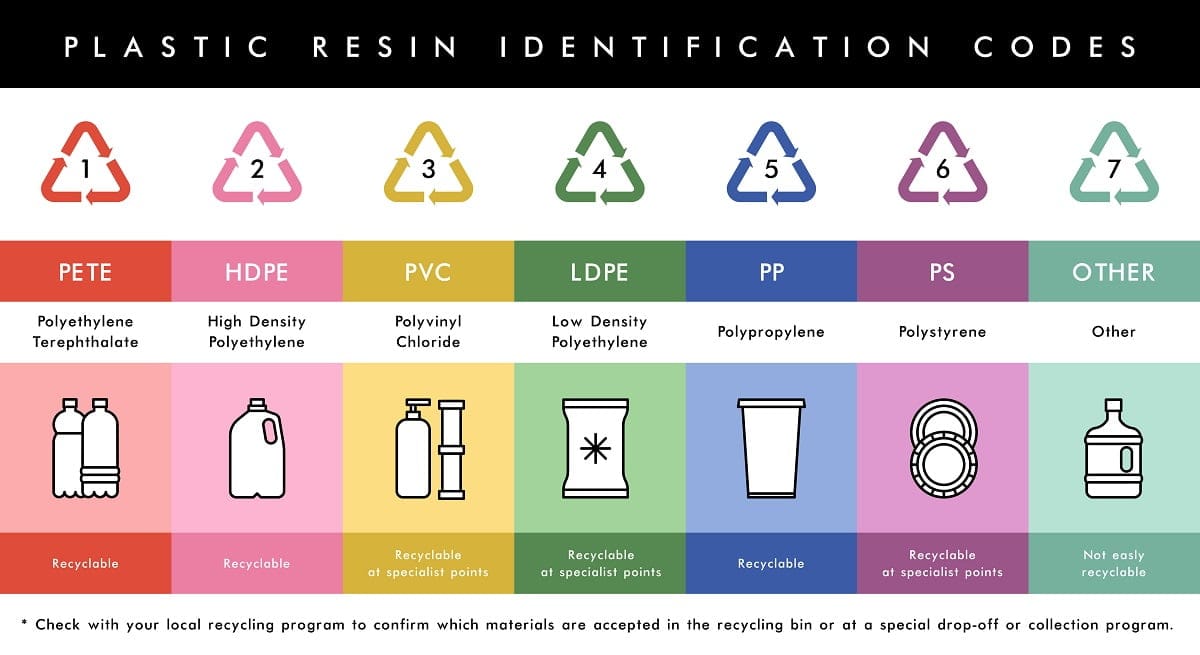
In order to overcome some of the confusion faced by consumers when knowing what can be recycled, APCO (Australian Packaging Covenant Organisation) launched the Plastics Identification Code on our Australasian Recycling Labels in 2018. The Plastics Identification Code makes it easier to identify plastics that can be reused in a variety of applications as per below:

1 PETE

Polyethylene Terephthalate (PET) bottles for water, soft drink, and fruit juice, as well as fruit punnets and meat trays.

2 HDPE

High-Density Polyethylene (HDPE) bottles for milk, bleach, and laundry detergent.

3 PVC

Unplasticised Polyvinyl Chloride (UPVC) bottles for cordial, liquid soap, and some fruit juice.

4 LDPE

Low-Density Polyethylene (LDPE) & Linear Low-Density Polyethylene (LLDPE) plastic bags, garbage bags, chip packets, plastic wrap, squeeze bottles, and black irrigation tube.

5 PP

Polypropylene (PP) bottles, bottle caps, and rigid packaging containers used for margarine, ice cream, and yoghurt.

6 PS

Polystyrene (PS) coffee cup lids, plastic cups, coat hangers, clamshells, medical disposables, and some yoghurt or dairy containers.

Expanded Polystyrene (EPS) foam packaging, packing peanuts, and Styrofoam boxes.

7 OTHER

Includes resins and other materials of unknown composition such as nylon, acrylic,  polycarbonates (PC), polyurethane (PU), and phenolics used in furniture, electrical, automotive, aircraft, marine, and medical parts. 

It’s important to note that these Plastics Identification Codes found on plastics only advise the different types of plastic resin used in each product. So just because it has a numbered symbol, doesn’t mean it is recyclable. For example, most hard plastics with a number 1 through 7 can be disposed of in your recycling bin, but plastic bags with a number 2 or number 4 and expanded polystyrene foam with a number 6 cannot. These should be recycled by a rubbish removal expert like Cheapest Load of Rubbish.

What Can You Do To Use Less Plastic?

While we should all be reducing, reusing, and recycling, it should be in that order of priority. In other words, recycling should ultimately be the very last line of defence against pollution. What we need to be doing first is choosing products with minimal to no waste at all, which reduces the need for them at all.

If it’s not a one-time use product, start by thinking about whether you need it at all. If you do decide it is a need and not a want, find out if there’s a similar non-plastic option available, whether from that manufacturer or elsewhere. If you have no other choice, look for plastic products that are already recycled, or find ways to reuse the product again as many times as possible.

When it comes to drinking containers, Australians use more than 1 billion so-called “disposable” coffee cups each year and millions of plastic straws. To help stop this, purchase your own reusable Keep Cup for coffees and stop using straws, even in take away restaurants. If you can’t do without a straw, buy your own reusable straw made of glass or stainless steel. You should also dispose of all single-use plastic bottles at container depots if available in your state.

At the shopping centre, choose bulk products and unwrapped produce where possible, and bring your own bags for vegetables. Purchase items like detergents in cardboard boxes instead of plastic bottles, as they are more easily recycled. If there are no other options than buying products in plastic containers, find ways to reuse them rather than throwing them away. Also, avoid cosmetics with micro-plastics and say no to balloons. Always wear natural fabrics, use cloth baby diapers, get a biodegradable toothbrush, and get involved with Clean Up Australia.

What can you do with non-recyclable plastics?

Because not all plastics and other rubbish can be recycled, the easiest thing to do is use a rubbish removal service like Cheapest Load of Rubbish. Not only can we determine what can be recycled, but we can also remove any other waste for you. Once all of your rubbish has been loaded onto our trucks, we take it all back to our headquarters for sorting and correctly distributing it all to transfer stations or recycling plants. We are proud of our recycling effort, with around 80 per cent of all waste we collect is reused or recycled.

To make a substantial difference, we all need to do better and improve our recycling habits. Together we can all help reduce our landfill, lessen our contamination of land, look after our waterways, and make our world a much better place to live.

Categories
Rubbish Recycling

Sustainable Swaps for One-Off Plastics

Single-use plastics is a term commonly used across media platforms today regarding our country’s environment. Plastics are seen everywhere we go. They are on our streets, in our homes, waterways, oceans, beaches and parks. The breakaway from the grasps of this environmentally hostile material is inescapable due to its popularity in manufacturing everyday items. So, instead of eliminating this material how can we as communities reduce the effects of single-use plastics on the environment?

What are single-use plastics?

Simply, these plastics are items which are used once and thrown away. The worst single-use plastics affecting our environment include products such as plastic bags, straws, drink stirrers, coffee lids and cups, food containers, cutlery, and plates, just to name a few. While these one-off use plastics are convenient and we may not think much of it in the checkout lines when asking for plastic bags to carry our groceries, these choices have serious impacts on our environment’s health. 

What you need to know about single use plastics, and how they affect the country.

How do these single-use plastics affect the environment? Perhaps plastic does its job too well? It is a pervasive material and has a history of utility yet, its existing source of development and the nonchalant way society discards it makes it hazardous to our environment.  It is estimated around 40% of plastics utilised daily are single-use only. These affect our environment in a multitude of ways:

Effects on the health of all of us:

At times, the question “how does plastic affect our country?” appears far removed from us as humans. Our environment, although needing help, is interdependent. Pollution from plastic can negatively impact not only the health and wellness of the environment but of humans as well. When our water becomes contaminated with micro-plastics, facilities that treat our water are not necessarily advanced enough to fully eliminated them from our usable supplies. This is damaging to our health as particle matter of chemicals from plastics themselves like methylene chloride harm the human respiratory system as well as cause headaches, skin irritation and fatigue. When our soils become contaminated by these single-use plastics it too influences our health, as our crops for our food supplies become damaged. These effects are very real and directly correlate to the abundance of one-off plastics circulation and production. 

Effects on our wildlife:

Like us, animals and sea creatures also suffer from the pollution plastics cause. This is seen when critters suffer from dehydration, starvation or suffocation as plastics are mistaken for food or cosy homes. If ingested choking can occur, or if they escape that fate, they may endure serious digestive tract damage. One-off use plastics like soft drink can holders, may entangle species and cause them injuries for example impede the movement of a bird’s wing or, we have all seen the damage they do to the growth of turtles if caught up in them. This especially is an eye opening answer to the question of how these plastics affect our environment. 

Effects on freshwater lakes, rivers, and streams:

Due to our society’s careless discard of one-off use plastics, our freshwater lakes, rivers and streams have become highly contaminated creating a negative impact on our water systems and environment. According to a study developed in 2016, a troubling number of micro-plastics were present in many estuaries and tributaries. These tiny plastics have come from decaying bags, bottles, toothpastes, polyester clothing, skin lotions and other sources. These affect our waterways as well as the ecosystem of aquatic life as they serve as efficient transporters of pesticides, trace metals and other harmful chemical pollutants. Thus, other hazards besides pollution are introduced into already threatened freshwater ecosystems. 

Effects on changing climates:

Yes, some plastics are derived from natural plant-based substances, but the vast-majority of these products are derived from petroleum and or natural gas. With the manufacturers of plastics continuing persistent, the emission of greenhouse gasses from the combustion of fossil fuels is also unrestrained. Research, utilisation and development of alternate materials for these one-off plastics like starch based polymers and milk proteins promises improvement in the future. In the mean-time, returning to paper bags and glass bottles doesn’t seem like such a retrograde.

Sustainable swaps you can make to reduce your use of one-off plastics.

According to the Department of the Environment and Energy’s current Australian plastics recycling survey, over 3.5 million tonnes of plastic was manufactured in Australia between 2018 and 2019, of which only 11.5% was recycled. An organisation named ‘Pacific Oceans’ estimated that around 380 million tonnes of plastic waste is created every year, and 50% of it is single-use. Becoming completely plastic free is understandably hard, especially when so many of our country’s daily essential items are developed from plastic or are packaged in unnecessary one-off plastics. It is also challenging to find sustainable options for our disposal readily available. The good news is that while Australia moves towards a ban on plastics as well as companies beginning to support the demand for environmentally friendly products, there are a multitude of ways we can start creating change and making a difference in reducing the use of one-off plastics. These may include:

1: Glass containers to replace plastic and snap-lock bags.

Give single-use plastic bags and containers the flick and opt for recyclable materials instead. An empty jar makes a perfect container to transport salad dressings or switching to glass storage containers for carting leftovers.  Small cardboard boxes like sultana boxes are perfect for your trail mix on the go.

  1. Glass or metal bottles for drinks

million plastic bottles are bought around the world every minute, according to a study by The Guardian, and in Australia alone, around 373 million plastic water bottles end up as waste each year. Instead of buying bottled H20, the most eco-friendly and cost-effective option is to just drink it straight out of a glass. But, if you’re on the go and don’t have access to water on tap, invest in a good-quality reusable drink bottle.  If you’re buying packaged beverages, look for glass bottles or easy-to-recycle cans over plastic. 

  1. Natural or microfibre cloths to replace synthetic cleaning sponges 

Plastic kitchen sponges harbour bacteria and germs and it is recommended that we replace them weekly, of course, this just adds to environmental waste with these sponges ending up in landfill in the masses.  Making the conscious decision to change to using an alternative such as microfibre cloths, hemp sponges, bamboo or wooden scrubbing brushes.  You can even get vegan dish blocks.

  1. Plastic straws for paper or metal

In Australia, we discard an estimated 10 million plastic straws every day.  Rather than add to this growing problem try switching to more sustainable alternatives, such as recycled paper straws, silicone, steel or glass just to name a few.

What Australians are doing to reduce waste and recycle responsibly. 

As mentioned above industries have progressively been moving towards banning these one-off use plastics. You may have experienced the change where plastic bags are now not given out at supermarkets but are either able to be purchased or you must use your own fabric bags. This dramatically reduced one of the most unnecessary single-use plastics within our environment. You also may have seen companies like McDonalds changing their straws from plastic to paper to support our countries’ need to reduce waste and change to sustainable products. 

Cheapest Load of Rubbish are dedicated to helping Sydney-siders reduce their use of single-use plastics in order to create a more sustainable future.  Contact us today to see how we can help you with plastic waste removal.

Categories
Rubbish Recycling

Easy “Green” Kitchen Swaps You Can Get The Kids Involved In

The world is rapidly using up resources, pollution is rife in the atmosphere, our waters are contaminated, and trees are being cut down at dramatic rates. If we don’t start taking care of the environment, it’ll lead to greater global warming – which will in turn lead to bigger, more damaging storms that are guaranteed to impact the world we live in. 

As the earth’s temperature continues to rise, ice caps will melt, resulting in a major sea-level rise, and major cities and even nations will disappear. Global warming will also impact our health – with asthma and allergies increasing as pollution does. 

As parents, we need to be taking care of our children in the best ways possible – and that includes taking care of their future. We want to help children understand the world around them – and of course, to educate them on the importance of their immediate environment. Crucially, we need children to know that the little things they do now will help them secure a brighter future. 

What Does It Mean To Go Green? 

Essentially, going green brings cleaner air, safer foods and better water quality. And although it might not seem important to many people, it not only benefits the world at large, but also improves your home life in general – it gives you a sense of purpose and accomplishment. 

Kermit said – “it ain’t easy being green”, but honestly, he’s full of it. It’s actually much easier than you think. Going green is a way of life – it allows you to do everything in your power to reduce, reuse and recycle. It not only helps you to embrace things in your life that are good for the environment, but it gives you a sense of accomplishment – knowing you’re doing what you can for future generations. 

The aim of going green is to reduce pollution and resources consumption, to eliminate the amount of waste we use, to conserve natural resources such as water, and to allow the natural environment to thrive.

Benefits Of Going Green At Home

We can all play a part in going green – and it starts in the home. By making simple changes, which we’ll go into later, you can not only help the environment and play a part in slowing down global warming… you can also change your own life. By going green, you will decrease your spending, reduce your energy bills, and live a much healthier lifestyle. Here’s a little more detail on the benefits: 

  1.     Reduce energy costs: by using solar energy instead of electricity, you can save yourself around $400 per annum, per kW of solar – so if you install an 8kW system, you’ll save around $3,400 a year.
  2.     Reduce impact on the environment. By reducing the amount of plastics and non-sustainable products you use around the home, you can lower your carbon footprint.
  3.     Healthier living. By going green, you’re committing to a healthier life in general – and that includes your diet. Ditching the plastics will have you stocking up on fresh foods instead, which of course are better for you.
  4.     Preserves natural resources, which leaves more for future generations. From switching to solar energy to using bore water to irrigate your gardens, planting trees, or changing the lightbulbs you use, you’re playing a part in preservation. 

Simple Kitchen Swaps You And The Kids Can Make 

You don’t need to give your kitchen a complete overhaul. Even the smallest changes can make a huge difference. Get the kids involved, teach them what needs to be done, and try these simple kitchen swaps that will benefit you and the environment: 

Throw out the paper towels. Although they’re certainly useful, they’re also a waste of a good tree and you’re better off using cloth, washable dish towels to clean up any mess instead. Stock up so you have plenty available when you need them. Did you know that to make one tonne of paper towels, it takes 17 trees and over 75,000 litres of water? 

Have a recycle bin handy. When you have a single bin in the kitchen, it’s much faster and easier to throw away your recyclables into your general waste bin, rather than taking a walk outside. Your best bet is to have two bins, and make sure the kids know which one is for general rubbish removal and which is for recyclables. If you don’t have the space for two bins, consider a dual bin instead. 

Use natural products for heavy cleaning. Get rid of the bleaches and harsh chemicals, and stock up instead on baking soda and vinegar. You’ll be surprised at how easy it is to clean tough stains with a good combination of these simple products – and they’re kid friendly! 

Stick to oils, or a reusable spray bottle. Cooking spray is convenient, but all those aerosol chemicals are bad for the environment. The cans are also hard to recycle. Instead, stick to bottle oils, or buy a reusable oil spray bottle. 

Update your kitchenware. Non-stick cookware is all the rage and it can create delicious meals – where nothing gets left in the pan. Unfortunately, though, they’re not great for the environment! They’re coated in chemicals that are actually harmful, so shop for stainless steel or cast iron instead. While you’re in the kitchen, ditch the single-use containers and utensils. Switch to reusable BPA free dishes and bamboo utensils. And teach the kids how to wash their dishes, rather than toss them in the bin. 

Forget the plastics. To start with, get rid of any single use water bottles you might have floating around and invest in a glass or stainless-steel bottle instead. Keep this on you throughout the day for refilling. Next, ditch the plastic bags. Rather than packing the kid’s lunches in disposable bags, switch to silicone designs instead – or simply store their lunch in reusable containers. And while you’re at it, throw out the cling wrap. It can’t be recycled, and it can actually leak harmful chemicals onto your food. 

It doesn’t matter how busy your household is, you can still reduce the amount of waste you create and it only takes a few minutes. Start with just a few simple steps, and you and the kids will be feeling proud and excited for all you’re doing to help the environment. And remember, if you need rubbish removal in Sydney to help get rid of your recyclables, we can help.